Website
A site that keeps itself current. Content published on schedule, pages tested, every lead routed to the right person within minutes.
Tulsa, Oklahoma. AI consulting and system builds.
I am Jeremiah Fehrle, an AI consultant in Tulsa. I build systems that run the website, marketing, sales, and operations work for businesses across Northeast Oklahoma, and I run my own company on them. Ten minutes of questions gets you a free one-page plan for your website, marketing, sales, and operations: what already works, what could improve, and where AI helps. Within one business day.
The plan is generated by the kind of system I build for clients. Reading it is the demo.
Everyone is using AI right now. Very few have figured out how to make it work inside their business. That is where I come in.
Where the work is
A site that keeps itself current. Content published on schedule, pages tested, every lead routed to the right person within minutes.
Ad accounts, content, and reporting run by systems that make the changes, not just the recommendations. Budgets move. Articles publish. The report writes itself.
Follow-up that never lapses. Proposals drafted from your call notes. A pipeline that stays current without anyone updating it on Friday afternoon.
Intake, scheduling, reporting, and the recurring admin that eats the week, handled by a system and logged, so you can see exactly what it did.
How it works
Company size, who does the work, what you have tried with AI, and where you think it could help. No jargon required. Not sure is a valid answer.
Your website and marketing checked from the outside, starting with what already works. Sales and operations shown as the patterns your industry runs into. It ends with an offer of a free 30-minute call to tailor it. Yours to keep either way.
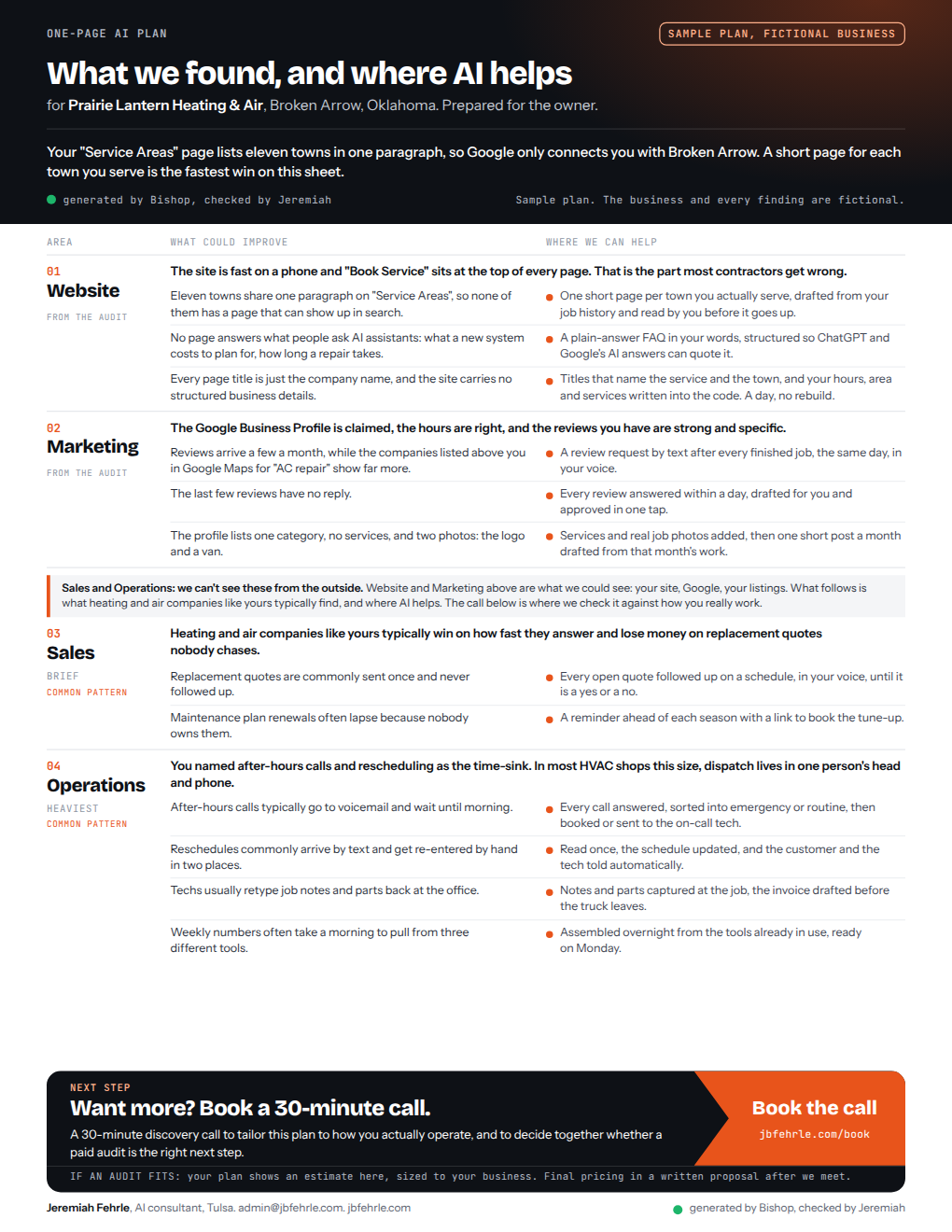 View an example Sample plan for a fictional business. Opens the full PDF.
If the call says it is worth it, I work inside your operation for a defined period, map the workflows, put numbers on the time and money at stake, and hand you a prioritized build plan.
Your team builds and I direct, teaching the operating method. Or I build it and you own it, on your accounts and your data. Builds start only after an audit. I do not build what I have not measured.
Why trust it
Bishop, an autonomous operator I designed and built, runs my ad operations, content production, reporting, and this website. Every action it takes is governed and logged. The figures on the proof page are live.
See the live figures →ProductAds Arsenal is BattleBridge's advertising platform for Meta, Google, and TikTok, and I am its lead engineer and co-owner. It reads every campaign, diagnoses what is not working, and turns the fix into a governed, one-click action.
The build record →PedigreeWeb design, analytics, media buying, multi-client operations, with other people's money on the line. That is where the judgment in the systems came from.
The full arc →Local
In person across the Tulsa metro, remote everywhere else. I would rather meet you than sell you. If you run a business here and want to talk about what AI could actually do inside it, book the call. The worst case is a good conversation.
Book a callTen minutes now. A one-page plan within one business day: what already works, what could improve, and where AI helps a business like yours.
Free. One business day. No obligation.